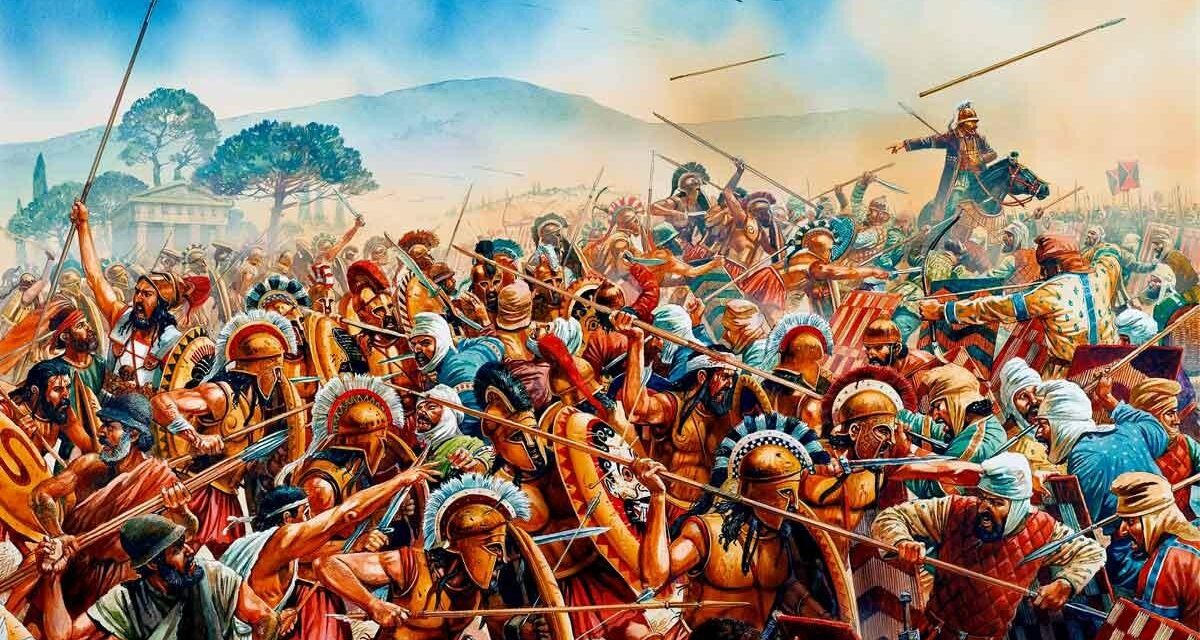
The Peloponnesian War — Athens Against Sparta
The success of Athens created growing concern among Sparta and its allies.
Athens possessed a powerful navy and controlled an extensive maritime network. Sparta was a major land power with a reputation for disciplined infantry.
Tensions between their competing alliances eventually erupted into the Peloponnesian War, which lasted from 431 to 404 BCE.
The conflict was not one continuous battle. It involved campaigns, temporary truces, shifting alliances, political upheavals, and fighting across several regions.
At the beginning of the war, Athens relied heavily on its fleet and fortified connections to its port.
Its strategy aimed to avoid a decisive land battle against Sparta’s army.
But in 430 BCE, a devastating epidemic struck Athens, killing a substantial part of the population.
Pericles himself died during the outbreak in 429 BCE.
The disease’s exact identity remains uncertain, although historians have proposed several possibilities.
The war continued for decades.
Athens launched a disastrous expedition to Sicily between 415 and 413 BCE, losing much of its expeditionary force.
Sparta eventually received Persian financial support that helped it build and sustain a stronger navy.
In 405 BCE, Spartan forces under Lysander defeated the Athenian fleet at Aegospotami.
Athens surrendered in 404 BCE.
The defeat ended its period of dominant imperial power and led to a short-lived oligarchic regime known as the Thirty Tyrants.
Yet Sparta could not permanently dominate all of Greece.
Rivalries continued, and Thebes later defeated Spartan forces at the Battle of Leuctra in 371 BCE.
The war illustrates the dangers of prolonged conflict between states that share cultural traditions but compete for political leadership.
It also weakened many Greek communities and created conditions that eventually allowed Macedon to rise as a dominant power.