The Fall of the Western Roman Empire
By the fourth and fifth centuries CE, the Roman Empire faced a complicated combination of political, military, economic, and demographic challenges.
The empire had increasingly operated through separate eastern and western imperial courts.
The eastern territories generally possessed stronger urban economies and greater access to important commercial resources, although they too experienced serious crises.
The western empire struggled with civil wars, political instability, fiscal pressures, and difficulty maintaining control over its territories.
Groups from beyond the frontiers entered Roman lands in growing numbers. Some fought Rome; others served in Roman armies or negotiated settlements with Roman authorities.
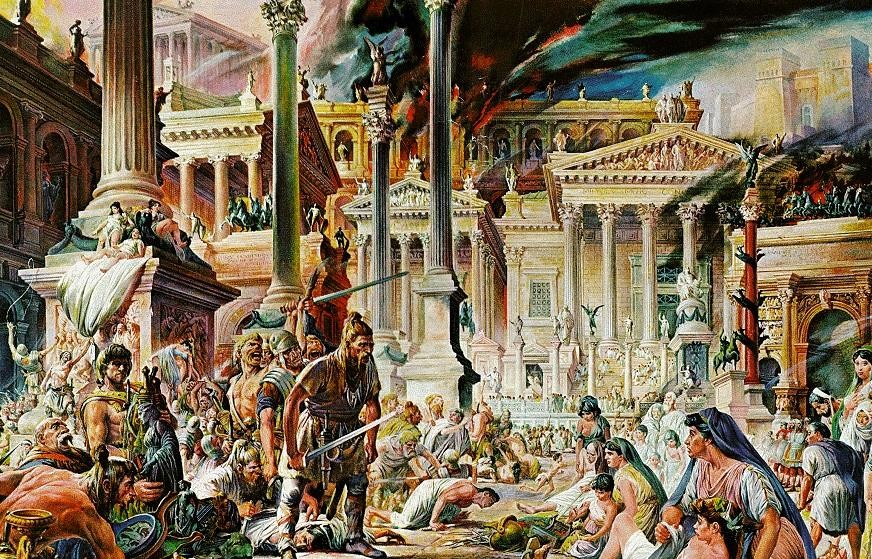
In 410 CE, the Visigoths under Alaric entered and sacked Rome.
The event shocked the Mediterranean world because the city had immense symbolic importance, even though it was no longer the empire’s principal capital.
In 455 CE, the Vandals also sacked Rome.
Finally, in 476 CE, the Germanic military leader Odoacer deposed the young western emperor Romulus Augustulus.
This date is traditionally used to mark the fall of the Western Roman Empire.
However, the Roman Empire did not disappear everywhere.
The eastern empire, governed from Constantinople, continued for nearly another thousand years.
Historians call it the Byzantine Empire, although its inhabitants generally understood themselves as Romans.
Under Emperor Justinian I in the sixth century, the eastern empire even reconquered parts of the former western territories.
Constantinople finally fell to Ottoman forces in 1453.
The fall of the western empire was therefore not a single moment when Roman civilization vanished.
It was a long transformation in which political institutions changed, regional kingdoms developed, and Roman traditions continued in new forms.