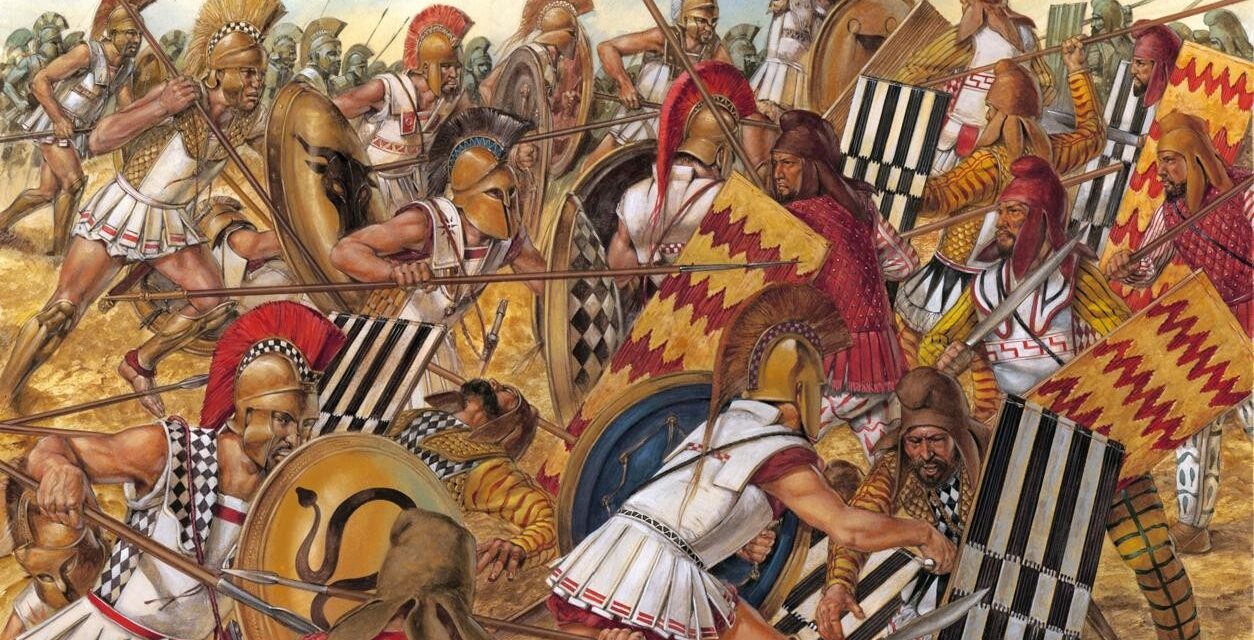
The Persian Wars — Greece Against a Vast Empire
During the early fifth century BCE, the Greek city-states faced a formidable opponent: the Persian Empire.
Persia was one of the largest and most powerful states in the ancient world, controlling territories across western and central Asia and beyond.
The conflict known as the Persian Wars began in the context of Persian expansion and the Ionian Revolt, when Greek cities on the western coast of Anatolia rebelled against Persian rule.
In 490 BCE, Persian forces invaded mainland Greece and fought the Athenians and their allies at the Battle of Marathon.
The Athenians won a celebrated victory, strengthening their confidence and reputation.
Ten years later, the Persian king Xerxes I launched a much larger invasion.
Greek forces attempted to resist at several locations.
At Thermopylae, a relatively small Greek force, including Spartans led by King Leonidas, fought against the invading army in a narrow pass.
The Greeks eventually suffered defeat, and Leonidas was killed.
The battle became famous for its symbolism of courage in the face of overwhelming odds.
But Thermopylae was only one part of a wider campaign.
The Greek fleet subsequently achieved a major victory at the Battle of Salamis in 480 BCE.
Greek ships used their knowledge of the narrow waters to fight the Persian fleet under difficult conditions.
In 479 BCE, Greek forces defeated the Persians at Plataea, while another major Greek victory occurred at Mycale.
The Persian invasion failed to bring mainland Greece under lasting Persian control.
These victories did not create a unified Greek nation.
Athens and Sparta remained rivals, and Greek city-states continued to pursue competing interests.
Nevertheless, the wars became a powerful part of Greek historical memory.
They also helped Athens build a maritime alliance that gradually developed into an empire over other Greek communities.
The Persian Wars demonstrate that military outcomes often depend not only on the size of an army
but also on strategy, geography, alliances, leadership, and the ability to coordinate resources.